Every hit is a word
No read, no hit. Every at-bat starts with a word read out loud, and harder words hit farther.
 Home Team SmartsReading games for kids 5 to 11
Every hit is
a word read.
Run It Home Words is a printable baseball board game for kids 5 to 11 where every hit is a word read out loud. It plays like real baseball: the bigger the swing, the farther it goes. A short word is a single. A harder word gets extra bases. It mixes baseball sight words and phonics with Action Cards for steals, diving catches and silly pranks. You’re the umpire, for 2–3 players, done in about 12 minutes.
A quick taste of the paper game. At the table, you flip real cards and slide bingo chips around the printed field.
On paper: flip the top card onto AT BAT, read it out loud, and the umpire turns it over to check.
The real game is played on paper, at the table, with a grown-up umpire, bingo chips and all 54 cards.
Real baseball. Real board game. Real reading. Kids already know how board games go: draw a card, move a runner, take turns. Add the moves of real baseball, and they want one more at-bat. No read, no hit. The at-bat is the practice.
of Ontario Grade 3 students aren’t meeting the provincial reading standard.
EQAO, 2024–25of US Grade 4 students read below the basic level, the most since 2002.
Nation’s Report Card, 2024more screen time a day before age 8 was linked to a 9–10% lower chance of top reading and math scores later.
SickKids and EQAO, 2025It doesn’t have to be this way. With sound-it-out teaching and early help, only about 1 in 20 kids would fall behind, Ontario’s Right to Read inquiry found. CBC News, 2022
No read, no hit. Every at-bat starts with a word read out loud, and harder words hit farther.
No flashcards, no nagging. You flip the card, check the back and call the hit.
A missed word goes on the TRY AGAIN pile. You sound those words out together for two minutes after the game.
Simple patterns first, harder ones later, the order phonics works best in. Source
Sounding a word out, again and again, is how it gets stored for good. Source
Missed words get practiced right after the game, by sounding out, never guessing. Source
Real choices keep kids motivated, and every card still needs a word read. Source
An adult tunes the help to each child, quietly. Source
Short board games built kids' number skills in four 15 to 20 minute sessions. This uses the same format for reading. Source
These studies didn't test this game. Family playtests are under way now.
Kids see only the word, so they sound it out instead of guessing from a picture.
The back shows the picture, the word and its sound boxes, so you can confirm the read and point to each sound.
T-Ball and Rookie cards mark each sound with a dot and each letter team with a dash. The tricky part of the word is in red.
Say “Look at the sounds” and tap under each one. Don’t say the word for them. Missed words go on the TRY AGAIN pile, and you sound them out together for 2 minutes after the game.
Minors and Majors split words into prefixes, bases and suffixes.
See below for how the decks line up with school in Canada and the US.
Word side: no picture, so kids decode the word. Tap a card to flip it.
Canada has no national curriculum; each province sets its own. We matched the decks to Ontario’s Language Foundations Continuum, Kindergarten to Grade 4 (2026), which goes with Ontario’s Language curriculum and Kindergarten Program. In the US, we used the Common Core reading standards: foundational skills for K, Grade 1, Grade 2, Grade 3 and Grade 4, plus Greek and Latin roots in Grade 5. Some states use their own standards.
| Deck | What it teaches | Ontario | US Common Core |
|---|---|---|---|
| T-Ball | Short vowels, blends, heart words, first sentences | K to Grade 1 | K to Grade 1 |
| Rookie | Digraphs, silent e, vowel teams, r-controlled vowels, two-syllable words | Grade 1 | Grades 1 to 2 |
| Minors | Endings with spelling changes, prefixes and suffixes, three-syllable words | Grades 1 to 2 | Grades 2 to 3 |
| Majors | Prefix plus base, Greek and Latin roots, long multi-part words | Grades 3 to 4 | Grades 4 to 5 |
Pick the deck by how your child reads, not by grade. A word-by-word check of every card against a published phonics teaching order is part of the playtest. Run It Home Words isn’t reviewed or endorsed by any ministry, school board or standards group.
Pick the deck by how a child reads, not by age. Each deck has 54 cards. Choose the one where the child reads about 4 words in 5 correctly. Deck names are baseball leagues, so no child gets a grade label.
Count the missed words after each game. Very few misses two games in a row? Move up a deck. Lots of misses two games in a row? Move down. The child's own reading decides, not wins.
Every deck has 5 blank cards. Write in this week's words from class, so the game follows what you're teaching.
Print tonight. Play after supper. Run It Home Words is a paper board game. There’s no app, no tablet and no account. Everything prints on letter paper with low ink.
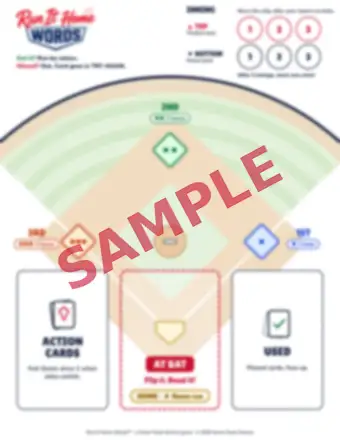
Letter paper, low ink: the field, two dugouts, a word deck and the Action Cards.
Cut the cards apart on the thin lines. Nine cards fit on each page.
A grown-up umpires. Runners are bingo chips you slide around the printed field.
Tap a page to see it full size.
24 cards, 7 kinds. Swipe to see them all.
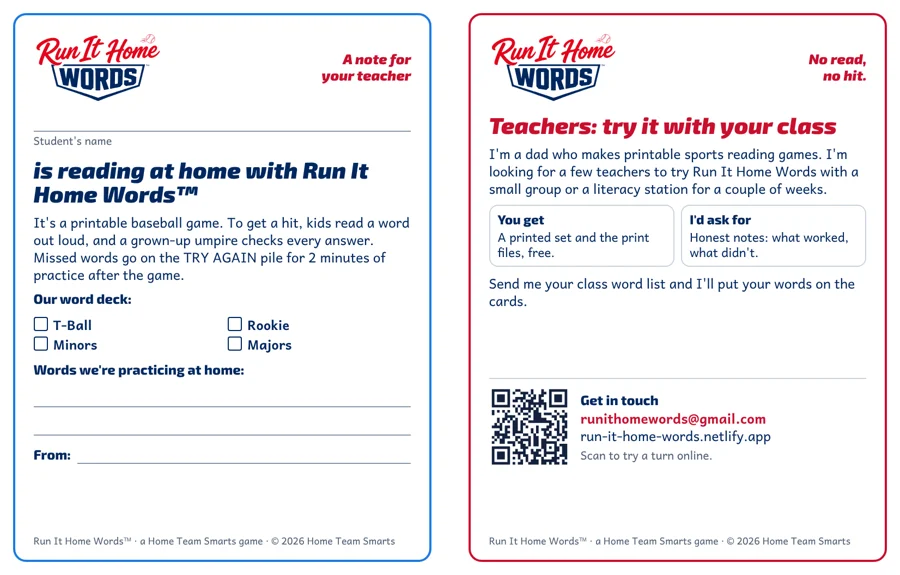
Send it to school with your child’s deck and this week’s practice words. The back invites the teacher to try the game with their class. Four notes print on one page.
Bring the game home, free. Run It Home Words is in its playtest, and families are playing it now. I’m looking for more homes, and a few classrooms, to help shape it.

I spent nearly 10 years working in post-secondary education. Then I watched my own son struggle with the usual ways kids are taught to read. He loves baseball and board games, so I put the two together. Run It Home Words is the game we play at our kitchen table.
Sven, a dad and the founder of Home Team SmartsQuestions? Email runithome@hometeamsmarts.com
Yes, and a phonics game. Most words are sound-it-out words, from CVC words like can and pig in T-Ball to digraphs, silent e and vowel teams in Rookie, with heart words (high frequency sight words) along the way. Pick the deck where your child reads about 4 words in 5 correctly.
2 to 3 players, with a grown-up as the umpire. Older kids can also play Kid vs Kid, where the fielder pitches and checks the back.
Yes. Every deck has 5 blank Teacher’s Word cards for this week’s class words, the kit includes a note for your child’s teacher, and teachers in the playtest can send their class word list to have their words put on the cards. It works in literacy stations for kindergarten and grade 1. Beginner decks include common sight words (heart words) like the, I, see, said and was. Words build in a step-by-step phonics order (CVC words, blends and digraphs, silent e, vowel teams, longer words), similar to the order used in structured literacy programs.
Nothing during the playtest. You print it at home on regular paper.
A printer, letter paper (cardstock makes sturdier cards), scissors and some bingo chips for the runners.
Kids 5 to 11. Pick the deck by how your child reads, not their age. The four decks go from first short-vowel words and sentences to Greek and Latin word parts.
It was made for kids like yours. A miss is an out, not a mistake: the word goes on the TRY AGAIN pile, and you sound it out together for two minutes after the game. Start with an easier deck so the hits come early.
Yes. Each child reads from their own deck, at their own level.
A grown-up is the umpire: you flip the card, check the back and call the hit. Older kids can also play Kid vs Kid, where the fielder pitches and checks the back.
No. It’s a paper board game for the kitchen table. That’s the point.
About 12 minutes. Short enough for a school night, and every at-bat is a word read out loud.
The decks follow the phonics order schools teach, from short vowel sounds to word parts. See “How the decks line up with school” above. Every deck also has blank Teacher’s Word cards for this week’s class words, and the kit includes a note you can send to your child’s teacher.